Soy industry giants leave zero-deforestation pact
The Amazon forest and the reputations of global traders are under threat as big agribusinesses leave the Amazon Soy Moratorium in Brazil.

SOY: A soy plantation in the Brazilian state of Tocantins in August 2020. Photo: Victor Moriyama/ Rainforest Foundation Norway
By Rainforest Foundation Norway.
In early January, the Brazilian Association of Vegetable Oil Industries (ABIOVE), a key actor in Brazil’s Soy Moratorium, withdrew from what is widely considered one of the most effective instruments for preventing commodity-driven deforestation in the world. With its withdrawal, major soy producers and traders, including Cargill, COFCO, ADM, Bunge, and Amaggi, are no longer part of the industry-wide commitment.
“The decision to leave the Soy Moratorium is an irresponsible action, and a serious setback for the fight to end deforestation,” said Ingrid Tungen, Head of Deforestation-free Markets at Rainforest Foundation Norway.
“This is in stark contrast to the growing global demand for deforestation- and conversion-free soy, and the urgent message of preserving climate and forests that Brazil championed during the climate conference in Belém in November,” she continued.

Ingrid Tungen, Head of the Deforestation-free Markets team at Rainforest Foundation Norway. Photo: RFN
The most effective agreement
After 18 years, the Soy Moratorium is widely considered to be the most effective instrument to prevent Amazon deforestation for soy production. Since 2008, just 2.1% of deforestation in monitored municipalities has been directly linked to soy, preserving more than 13,000 km² of forest, according to WWF Brazil.
Over the same period, deforestation fell by 69% while soy cultivation in the Amazon biome grew by 344%, showing that the agreement successfully directed soy expansion away from Amazon deforestation.
Between 2007 and 2022, most new soy plantings occurred on already-cleared land, reducing the environmental, climate, and reputational risks directly linked to soy in Brazil.
“The moratorium is not dead.”
ABIOVE’s decision to withdraw followed new legislation in the state of Mato Grosso, effective from the 1st of January, that removes fiscal incentives from companies that are part of voluntary agreements, such as the Soy Moratorium, that go beyond Brazilian environmental legislation. The new legislation in Mato Grosso, which was pushed for by the agrilobby in Brazil, is currently being challenged in the Brazilian legal system as unconstitutional.
Meanwhile, the Soy Moratorium remains legal and in operation. The withdrawal reflects a choice by companies and ABIOVE to abandon the collective commitment to protect the Amazon in response to fiscal incentives, rather than any change to the moratorium itself.
“The soy moratorium is still both valid and working. We are reaching a time in the global fight to curb climate change when good forces must step up, as others pull out. Continued commitment to the Soy Moratorium is no exception,” Tungen said.
She encouraged companies along the supply chain to continue their commitment to the moratorium and ensure a deforestation free soy sector. This is especially true for international buyers of Brazilian soy, who now face increased deforestation risks and cannot assume that these risks are being managed by their suppliers. Clear and explicit expectations of deforestation-free soy must therefore be communicated.
Soy’s hidden deforestation
“The production of soy in Brazil has more than tripled in the last 25 years. This is linked to the growth in global demand for Brazilian soy, both for the production of animal feed in many parts of the world, but also recently the production of biofuels, both in Brazil and in other regions of the world,” said André Campos, research lead at the organisation Repórter Brasil.
He explains how the expansion of soy production is already linked to the conversion of forest areas in different biomes. There is direct deforestation through the conversion of land for soy production in the Cerrado and the Amazon. There is also the indirect impact of soy expansion, linked to the entry of the grain into areas previously occupied by other activities, especially cattle production.
“From the moment that soy became the most profitable way to use these areas, there is a tendency to push Brazilian cattle and the expansion of cattle ranching to new frontiers, in the Amazon, the Cerrado, the Pantanal and other Brazilian biomes,” Campos said.
Improved infrastructure, both railways and paving of roads that cut through native forest, stimulates soy expansion and trade, as well as land-grabbing and speculation.

SOY:The growing demand for soy beans is a driver of deforestation. Photo: Shutterstock
High stakes
The conversion of increasingly more forest into cultivated land poses not only dangers for the forest’s ability to maintain fundamental ecosystem services like the production of rain, but it is also making the forest uninhabitable for animals and people living in close proximity to the agricultural land.
“The impact is huge,” said Watatakalu Yawalapiti. She is the political coordinator for ANMIGA (National Coordination of Indigenous Women) and the director of territorial ethno-development within the Xingu Indigenous Land Association.
“The river has dried up; we no longer drink water from the river. In some places, fish are contaminated with pesticides. We no longer eat the animals, and the communities that are nearby have to go very far to find food because the animals, the fruit, everything there is full of poison.”
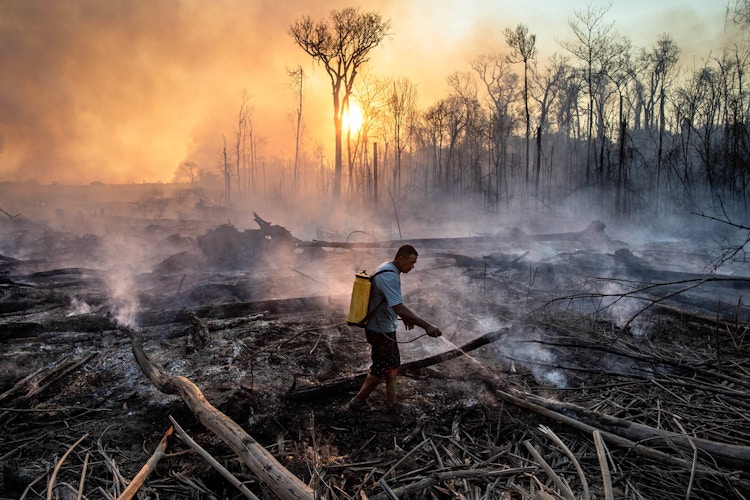
FIRE: A local man from a community in the Brazilian state of Mato Grosso tries to put out the fire from an illegal burning in an Environmental Reserve area in the Amazon rainforest. Photo: Victor Moriyama/RFN
Increased risk for global players
During the nearly 20 years the Soy Moratorium has been in effect, international demand for deforestation- and conversion-free soy has grown considerably. The withdrawal of some of the world’s largest soy producers from the agreement could create challenges for global actors.
The decision exposes investors and global buyers to significant risk, opening the door to increased deforestation in supply chains and placing a heavier due diligence burden on the market.
“At this moment, continued commitment from companies is critical. International buyers, in particular, must actively use their market influence to uphold the Soy Moratorium, clearly communicate expectations of deforestation-free soy to suppliers, and ensure that hard-won progress toward zero deforestation in the soy sector is not rolled back,” urges Ingrid Tungen at Rainforest Foundation Norway.
Contact:

Ingrid Tungen
Head of Deforestation-free Markets
(+47) 414 73 806
ingrid.t@rainforest.no